


What if one email could change the path of your venture?
For Julia Zislis, a recent University of Michigan graduate with a BA in Studio Art and a minor in Entrepreneurship, that is exactly what happened.
Julia was introduced to the Center for Entrepreneurship through a CFE newsletter at a time when she was seeking support and direction.
“I had recently declared my entrepreneurial minor and was unsure about what resources were available to support me,” Julia shared.
That email led her to Fuel, CFE’s student startup funding program, and helped her take the next step with Letwork, a secure, student-focused platform that simplifies subleasing.
Letwork began during a semester abroad, when Julia and another student noticed a problem many students face.
“We realized that thousands of students face the shared frustration of subleasing back home in the United States,” she says. “This is where Letwork was born.”
As Julia and her co-founder, Leah Lavoie, looked for campus resources, the CFE newsletter introduced them to Fuel and showed them how non-competitive funding could support their early work.
“We immediately completed an application for Fuel funding, and were fortunate enough to be one of their grant recipients,” Julia recalls. “So long story short, a singular email had changed the trajectory of our venture, and my future experiences with the Center for Entrepreneurship.”
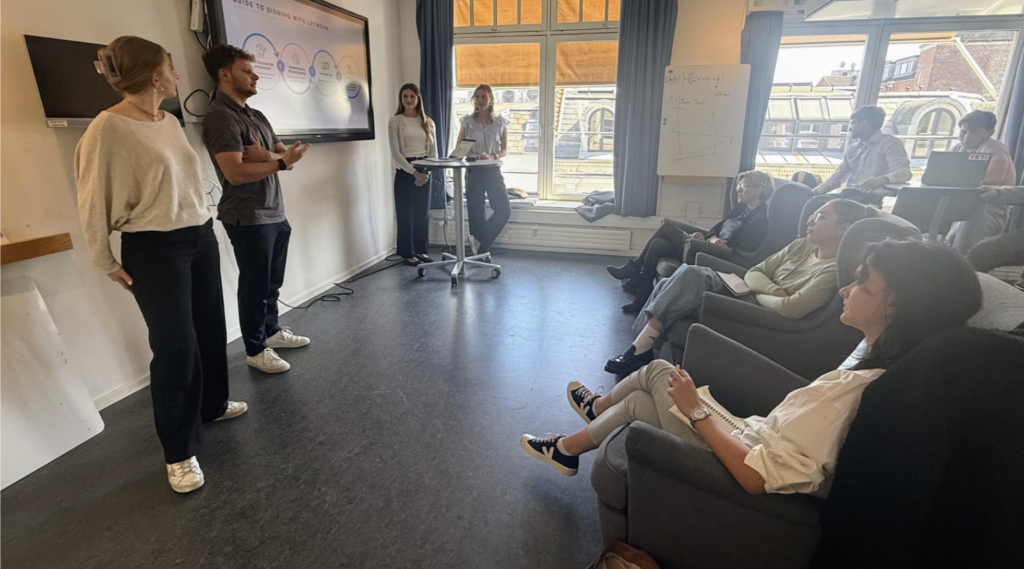
Learning to Build With an Open Mind
For Julia, entrepreneurship is rooted in vision, risk, and the ability to adjust.
“To me, an entrepreneurial mindset means maintaining an open mind while also being willing to take risks,” she says. “It is about having a vision, but also knowing when to adapt and pivot when obstacles come your way.”
Julia developed this mindset while building Letwork. She and her co-founder, Leah, worked with two software developers to turn their UI/UX prototype into a working platform. As a Studio Art graduate with an interest in UI/UX design, Julia cared deeply about the product’s look and feel.
“At first, I approached the process from a very design-focused perspective,” she recalls. “I wanted every detail from our Figma prototype, down to the buttons and stroke weights, implemented exactly as envisioned.”
The team soon had to make hard choices. Julia wanted to protect the design. The developers focused on launching a functional MVP first, with more polished design elements added later.
“Experiencing this forced my co-founder and I to really put ourselves in their shoes and understand their perspective rather than staying rigid in our own expectations,” she recalls. “We realized that if we wanted to move Letwork forward, certain aspects of the platform needed to be prioritized while others had to be placed on the back burner for the time being.”
That shift became one of many pivots.
“Through this experience, I learned that entrepreneurship is not just about sticking firmly to your original vision,” Julia explains. “It is also about adaptability, collaboration, and being willing to compromise in order to create something that can continue to grow.”

Finding Confidence Through CFE
Fuel gave Julia the funding she needed, but it wasn’t just about the money. Fuel gave her a place to test ideas, hear feedback, and see what entrepreneurship looks like in practice.
“The Center for Entrepreneurship, especially Fuel, helped me realize that all startups and early entrepreneurial ventures begin with an idea,” Julia says. “Whether someone is far along in the process or just starting out, entrepreneurship is really about vision, passion, and being willing to pursue something uncertain.”
Through CFE, Julia connected with peers, entrepreneurs, and other student founders. Those conversations helped make the process feel more real.
“Being surrounded by so many people creating and building their own ideas made everything feel much more real and attainable to me,” she says.
It also helped her get more comfortable sharing her work.
“As I became more comfortable sharing my ideas with others, I also became more comfortable with the uncertainty that comes with entrepreneurship,” she explains.
Advice for Future CFE and ENTR Students
Julia’s advice to future CFE and ENTR students? Don’t wait to get started.
“Take advantage of any and all opportunities and resources at your disposal,” she advises. “It may seem redundant at first, but the more experience you have and the more relationships you build, the more it will set you up for your future professional careers.”
Looking back, Julia wishes she had connected with CFE earlier.
“I learned the importance and value of CFE resources at the end of my Michigan career,” she says. “It was my biggest regret. Once I leaned into one sector of CFE, I was opened up to a whole new world of support and opportunity.”
Her experience with CFE and Fuel left a lasting mark.
“I will forever be thankful to CFE and Fuel for supporting me, my creative journey, and my newly launched venture,” Julia says.

Looking Ahead
As a recent graduate, Julia is now focused on building a career in visual graphic design or UI/UX design.
“I am hoping to gain a full-time position in either visual graphic design or UI/UX design,” she says. “As a recent graduate, I have been looking for a role that I can be challenged in, be given growth opportunities, and forge new connections.”
While she searches for the right role, Julia continues to build her design experience through Letwork’s social media graphics and consultative design projects.
Julia’s story shows that entrepreneurship can start close to home: with a common student problem, a prototype, a conversation, or even a newsletter. For Julia, one email opened the door to funding, support, and a community of builders.
Now, she is using her creative skills to shape what comes next.