

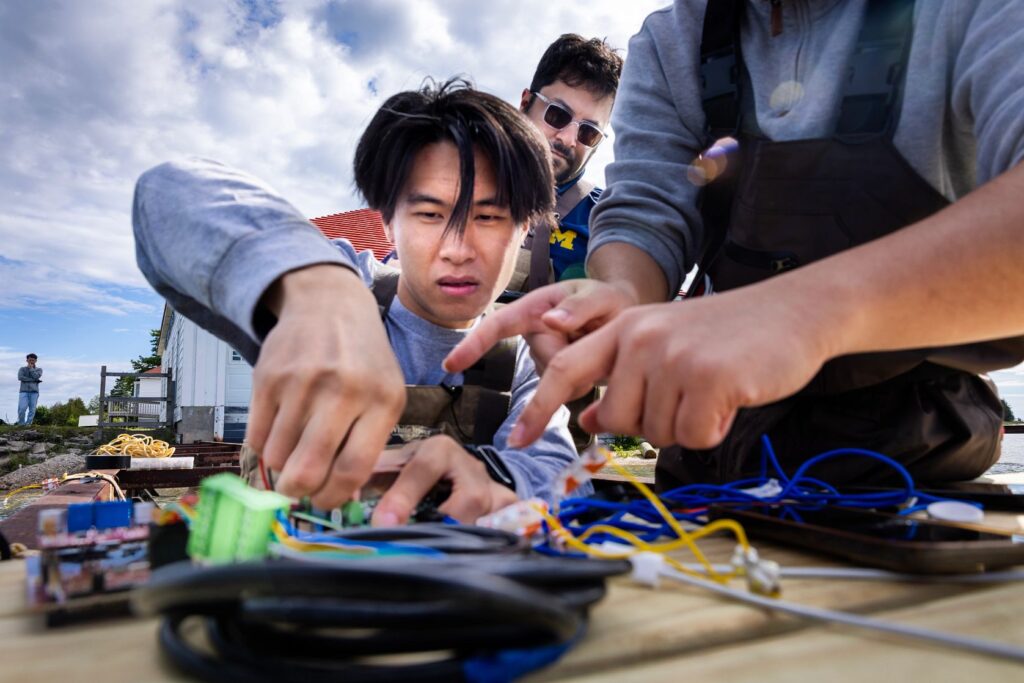
ANN ARBOR, Mich. — The Center for Entrepreneurship (CFE) at the University of Michigan announces the 2027 startup cohort for the Perot Jain TechLab Climate Change program. Following an intensive summer recruitment drive that drew numerous impressive applications from global climate-tech startups, six ventures were selected to collaborate with U-M student teams.
PJTL Climate Change offers students a distinctive chance to acquire practical entrepreneurial experience by engaging with startups developing carbon-reducing, sustainable technologies. Startups in Pre-Seed to Series B stages are matched with multidisciplinary student teams for two semesters. Startups gain high-level technical R&D support and access to U-M computing and laboratory infrastructure at no financial cost, while retaining all project IP. In contrast, students gain mentorship from global climate leaders.
Nick Moroz
CFE Director of Entrepreneurial Education & Director of the Perot Jain TechLab ProgramsThe 2027 PJTL Climate Change companies and projects include:

ICODOS (Mannheim, Germany) — ICODOS leverages patented hybrid processes merging CO2 capture with e-methanol synthesis. Students will construct an AI-assisted screening pipeline, Aspen Plus process co-simulations, and techno-economic assessments (TEA) to evaluate solar-driven photocatalytic hydrogen generation combined with Light-Swing Absorption (LSA) oxygen removal.
Octavia Carbon (Nairobi, Kenya) — Octavia Carbon is the Global South’s first Direct Air Capture (DAC) company, designing, manufacturing, and deploying geothermal-integrated DAC machines in Kenya’s Rift Valley for permanent geological storage through CO2 mineralization. Students will conduct experimental analyses of data to establish critical operating windows (residual oxygen thresholds, vacuum levels, and cooling temperatures) to prevent sorbent degradation.
Naaman Kiprono
Process Optimization Lead
twelve. (Burgos, Spain) — twelve. It is an impact financial app that automatically directs everyday credit card cashback rewards into cause-aligned sustainability portfolios. Student teams will build the data pipelines and impact measurement methodology required to translate daily consumer transactions into verified, auditable carbon offset and environmental metrics.
Lucas Olivella
CEO & Co-founder of twelve.
Solmeyea (Athens, Greece) — Solmeyea utilizes its patented CO2-utilization biotech platform via microalgae fermentation to transform industrial CO2 into healthy, nutritious, safe, and highly functional, nutrient-rich protein ingredients (MEY™). Student teams will develop and demonstrate a commercialization decision-support framework for MEY™, including market segmentation and evaluation of go-to-market strategies for B2B food ingredients and consumer Ready-to-Drink superfood products.
Vasilis Stenos
Co-Founder & CEO, Solmeyea Biotech
Low Carbon Materials (Seaham, United Kingdom) — Earthshot Prize finalist Low Carbon Materials manufactures ACLA, a carbon-negative drop-in aggregate for asphalt and concrete that locks away ~800 kg of CO2 per ton. Students will test ACLA against US aggregate standards (ASTM/AASHTO) and map state DOT procurement and approval pathways for US market entry.
With support from students at The University of Michigan, we aim to map our route to the US market by understanding procurement pathways and the requirements for alignment with US construction material standards.
Natasha Boulding
Co-Founder & CEO, Low Carbon Materials
Nordlys (Turin, Italy) — Nordlys, a 2026 GenAI Zürich semifinalist, is an AI supply chain intelligence platform built on Matryoshka representation learning and LLM-based reranking, with carbon footprint and supplier risk natively incorporated into its scoring. As carbon capture scales, its supplier ecosystem remains fragmented and largely uncharted, a bottleneck to deployment. The student team will formalize a domain ontology of the CCUS (Carbon Capture, Utilization, and Storage) supply chain and build the first open, reproducible benchmark of its supplier ecosystem, running Nordlys’s pipeline on U-M’s Great Lakes HPC cluster to deliver an explainable natural-language sourcing demo that returns ranked, auditable supplier shortlists.