

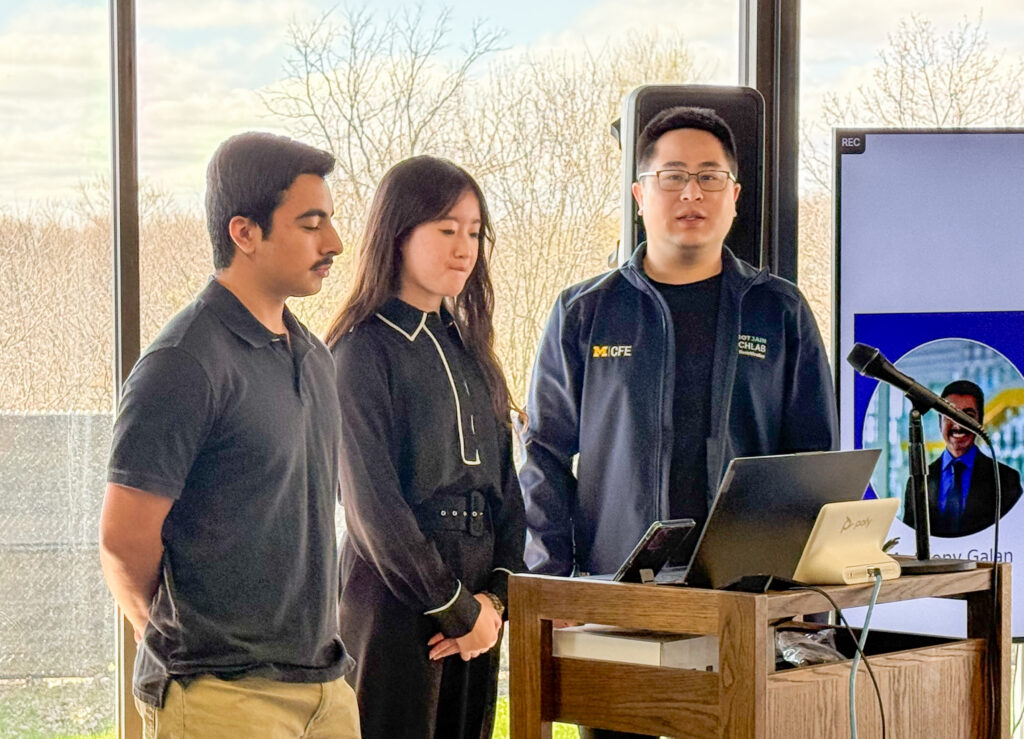
ANN ARBOR, Mich. — The Center for Entrepreneurship (CFE) at the University of Michigan has officially announced the six clean-tech ventures selected for the 2027 Perot Jain TechLab Electrification program. The cohort was finalized in July following an extensive summer recruitment effort that attracted more than 20 company applications from across North America, Europe, and Africa.
PJTL Electrification engages students in hands-on projects with high-growth ventures advancing electric vehicle systems, battery management, smart grid integration, and charging infrastructure. Participating startups are paired with four-person student teams studying Electrical Engineering, Computer Science, Materials Science, Business, or any other relevant academic path for two consecutive semesters. Startups gain access to U-M’s Electric Vehicle Center and its state-of-the-art battery labs, Great Lakes High-Performance Computing cluster, advanced testing labs, and student talent pipelines without giving up equity or IP. In contrast, students gain mentorship and real-world execution experience.
Nick Moroz
CFE Director of Entrepreneurial Education & Director of the Perot Jain TechLab ProgramsNow entering its third cohort, PJTL Electrification has become a significant talent pipeline for the industry, with multiple graduates from the program turning internships with participating companies into full-time roles. Other graduates have secured positions at OEMs, including Tesla, Lucid Motors, Daimler, and Caterpillar.
PJTL Electrification 2027 companies and projects include:
Carbon Zero Mobility (Nairobi, Kenya) — Carbon Zero Mobility manufactures Dominion™ EV electric motorbikes tailored for African last-mile logistics. Building on its prior design work and business model in partnership with Daystar University, student teams will prototype, develop, and deploy an open-source, digital energy-metered charging socket for Dominion™ electric two-wheelers, featuring integrated mobile money payment APIs (such as M-Pesa and Airtel Money) alongside real-time consumption telemetry.

Wheelhouse (Dover, DE) — Wheelhouse is a modular, secure, weather-protected e-bike and micromobility parking solution featuring integrated charging, smart access, and scalable configurations designed for quick installation across campuses, transit hubs, and urban spaces.Students will evaluate Wheelhouse’s modular e-bike storage and charging system in a real-world campus setting, testing usability, safety, installation, and operational requirements to help advance the prototype toward scalable commercial deployment.
David Bell
Co-founder and CEO of Emerald Battery Labs.
Spark Connect (Istanbul, Turkey) — Spark is an identity-first Mobility Operating System and SuperApp unifying fragmented EV charging, parking, micro-mobility, and transit services. Student teams will validate and prototype new ecosystem MiniApps (insurance, roadside assistance, rentals, transit) featuring unified single sign-on (SSO) authentication and RESTful API integrations.

Rollyy (Porvoo, Finland) — Rollyy develops AI-driven autonomous mobile charging robots that turn any parking space into an on-demand EV charging bay without costly grid retrofits. Working alongside Rollyy engineers, U-M student teams will develop high-fidelity physics simulations in NVIDIA Omniverse and Isaac Sim to advance vision-guided charging-port localization, autonomous fleet navigation, and precision robotic manipulation.
Dave Vasquez
Founder & CEO, Rollyy
Electric Outdoors (Southfield, MI) — Electric Outdoors builds off-grid infrastructure platforms (EO Canopy) that integrate solar Level 2 EV charging, battery storage, and atmospheric water generation. Students will model, instrument, and validate a cold-weather resilience energy architecture and Smart Energy Management System (SEMS) control logic operating under extreme winter conditions in Northern Michigan.

ChargerHelp! (Los Angeles, CA) — ChargerHelp! uses trained field operations and data analytics to maximize the uptime of public EV charging equipment. Students will build a component-level predictive reliability model by combining four years of historical field maintenance records with hands-on benchtop failure analysis of returned charging hardware.