

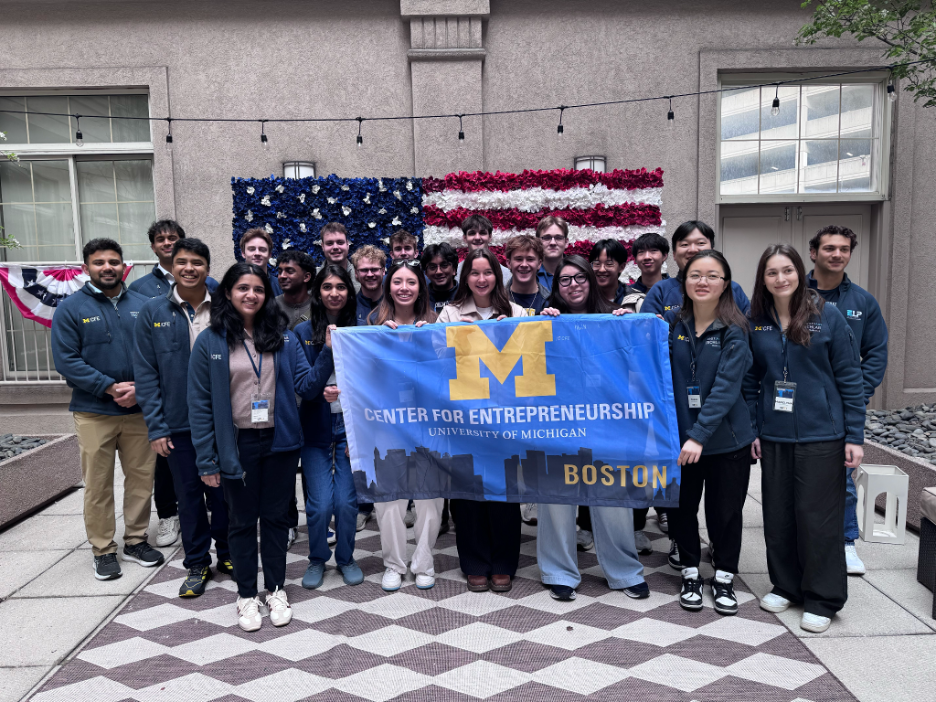
Contributed by Anjali Arora, PJTL 2026 HealthTech Cohort, Master’s in Data Science, and Michael Ettlinger, ELP 2026 Cohort, Master’s in Sustainable Systems: Climate and Energy
In a city praised as one of the world’s leading entrepreneurial hubs, including dozens of universities, research institutions, accelerators, and venture networks, innovation does not feel accidental. It feels engineered.
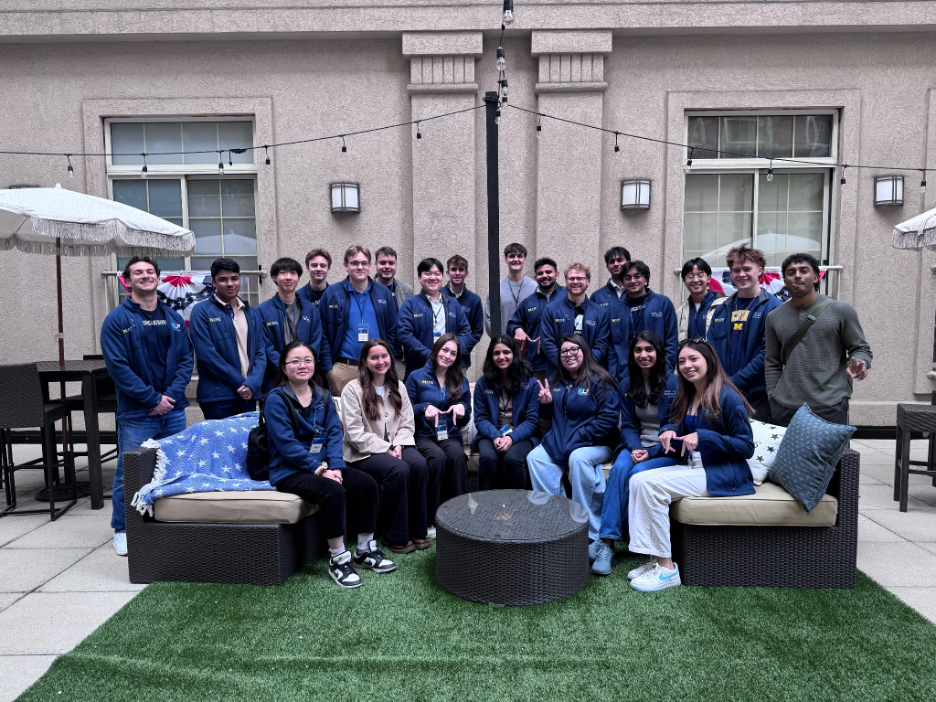
From May 3 to May 6, twenty-four students from the University of Michigan’s Center for Entrepreneurship’s Perot Jain TechLab and Entrepreneurial Leadership Program cohorts explored Boston, visiting startups across manufacturing, robotics, materials, construction, and medtech.
This immersive experience is not just a trek, but a study in how world-class ecosystems are built.
Day 1 began quietly, with flights landing, luggage rolling across the hotel lobby floors, and strangers turning into teammates over dinner tables. By the time we sat down that evening, Boston already felt less like a destination and more like a living laboratory.
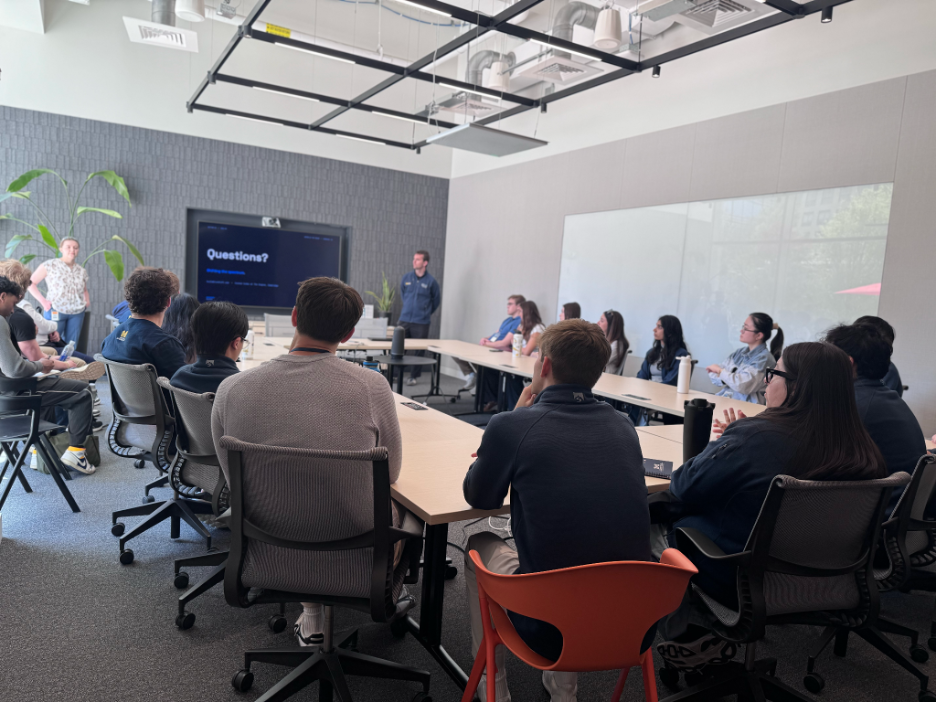
Insights from Jules Pieri on Building Your Brand
The next morning, we found ourselves overlooking the Bay at the residence of Jules Pieri where she shared insights into her unique entrepreneurial journey and offered advice for us as early-career professionals. Her “three pillars” of Resume, Reputation, and Relationships laid the foundation for a theme that continued to emerge throughout our journey: dedication and discipline are the bridge from wide-eyed ambition to earning a trusted professional brand.
Inside BlueShift at The Engine
Next, we enjoyed being generously hosted by BlueShift within The Engine: The Home for Tough Tech, where industrial waste is processed into critical minerals. This stop served as a reminder that cutting-edge innovations can be restorative rather than extractive. Their small yet growing team, which is commercializing technology developed in collaboration with the University of Michigan and Harvard University, exemplifies the power of identifying opportunities, setting intentions, and recruiting the right people to transform essential industries.
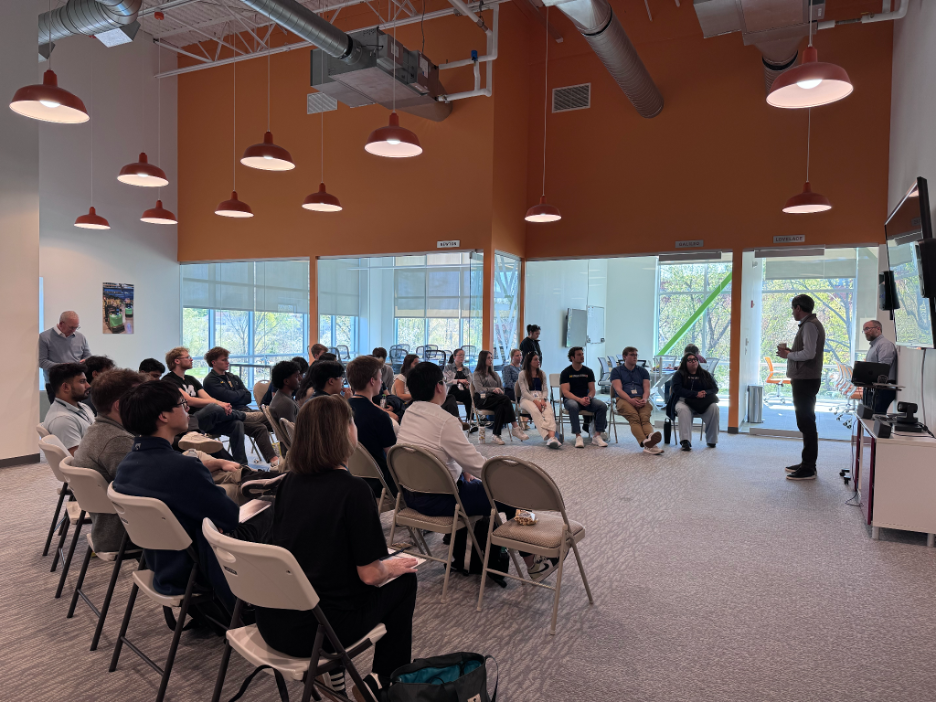
Autonomy in Action at Vecna Robotics
The final stop of Day 2 was at Vecna Robotics, which brings autonomy to life with robotic, automated warehouse equipment and software that streamlines inventory management and logistics. Our group was stunned by the precision with which these machines operated, and we were asked to pitch alternative use cases for Vecna’s technology to the company’s leadership in a humbling test of our imaginations–the innovation challenge–pushing us beyond admiration and into strategy. In this, student teams were tasked with identifying a high-value market outside warehousing based on technology applicability, potential market size, revenue streams, and operational feasibility under time pressure.
Kudos to one of the 6 teams, “Wolverines”, who won the challenge!
From Design Iteration to Operating Room Impact
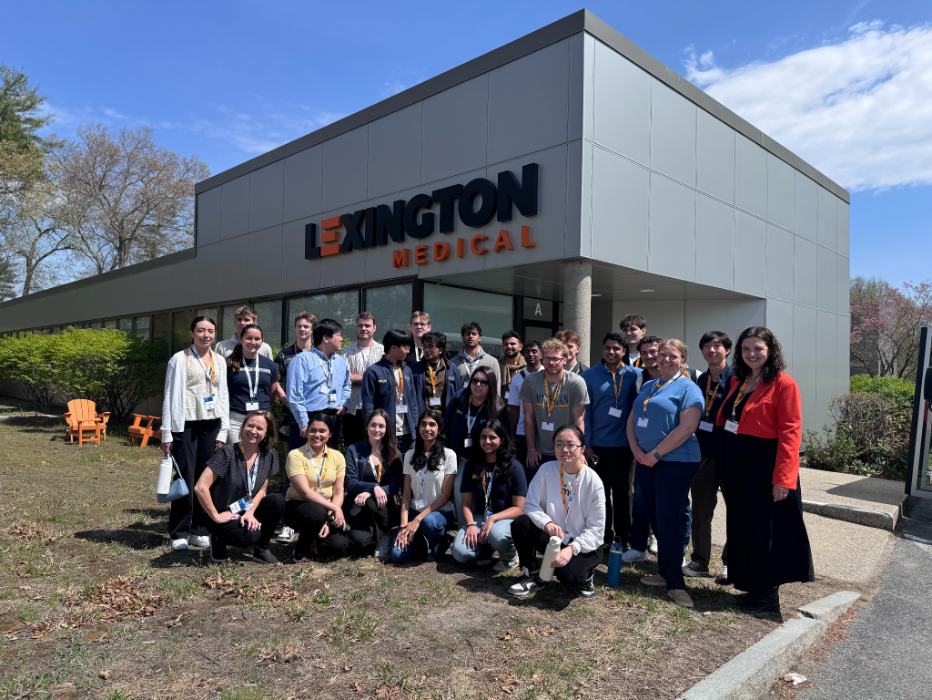
Day 3 kicked off with a visit to Lexington Medical, where the results of calculated market entry and product design iteration were on full display. This facility contained all facets of Lexington Medical’s business under one roof, allowing us to observe the carefully crafted manufacturing that ensures doctors in the operating room receive the best tools possible for their patients.
Reimagining Housing with AI
How far can we let our imaginations run when it comes to artificial intelligence?
The possibilities unfolded in real time when we saw AI converge with the construction industry during the second visit on Day 3 to Reframe Systems, a modular housing company redefining construction. Similar to Henry Ford’s groundbreaking implementation of the assembly line, Reframe gains a leg up on its competitors by automating the assembly of its units with precision and speed. This visit challenged the notion that craftsmanship must be slow and labor-intensive to produce high-quality products, while demonstrating how America’s urgent need for housing supply can fuel rapidly expanding businesses that meet that need.
MIT Scavenger Hunt: Lessons in Innovation Density
Our third day, which began with enthusiasm, ended with perspective. All thanks to a scavenger hunt hosted by MIT, which was not a campus tour but a living lesson in ecosystem design and exploration.
Teams navigated MIT landmarks, identifying lab spaces, innovation corridors, and research hubs, not just to “find” them but to understand how proximity fuels effective collaboration. It quietly demonstrated how the density of human and physical capital compresses the space and time between ideation and execution.
Congratulations to the winning team that immersed itself in this active lesson on intentionally building innovation clusters!
Where Hardtech Scales Like Software
Our final day in Boston included one company visit with VulcanForms, where the art and science of additive manufacturing are applied to advanced metal products serving customers in sectors ranging from transportation and defense to energy and computing. Here, we heard from inspiring company leaders, witnessed the operation of state-of-the-art manufacturing technologies, and gained insights into the strategic thinking that allows hardtech businesses to grow at the same rate as software startups.
Closing Out Our Boston Experience
Boston did not showcase ambition alone. Rather, it depicted a city where the immense capabilities enabled by coordinated collaborative systems, innovative craft, and patient iteration empower the creation of lasting products, services, and organizations.
In addition to serving as a reminder of the historical and cultural context from which the world’s largest economy emerged, this transformative trek supplemented our educational and professional journeys by highlighting how taking the road less traveled can make all the difference in the lives of relentless innovators and in the sectors that underpin the backbone of industries that move the world forward.