

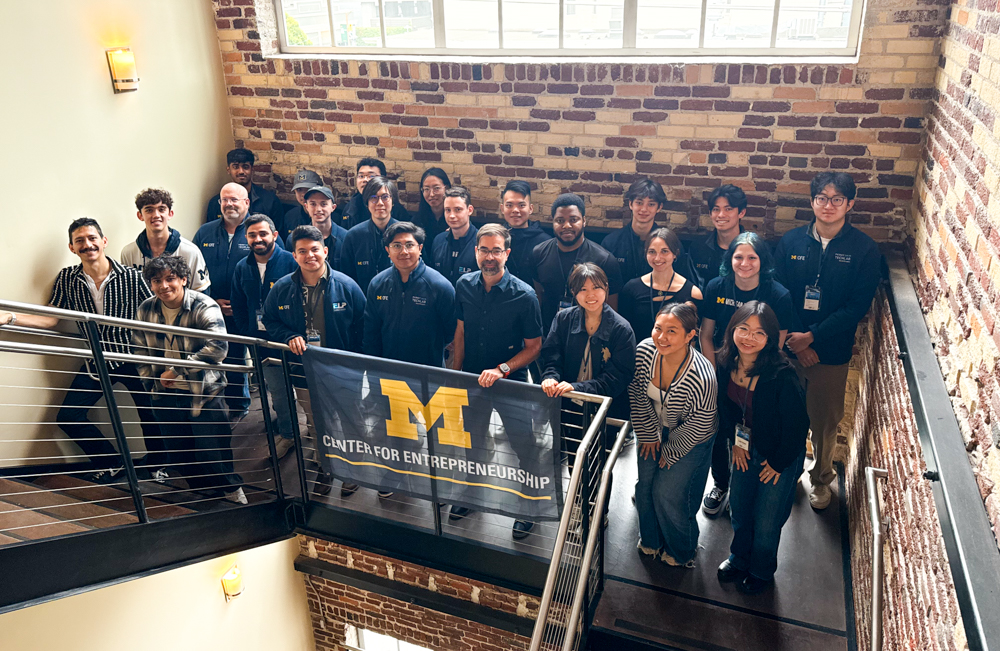
Contributed By Val Amiel Vestil, 2026 ELP Cohort, Master’s Student (2027) Environment and Sustainability with Behavior, Education, and Communication
This May, the Center for Entrepreneurship brought students to San Francisco for the WUST immersive trek into the world of startups, innovation, and entrepreneurship. Through company visits, networking opportunities, and conversations with industry leaders, students gained firsthand insight into the Bay Area’s entrepreneurial ecosystem.
We asked ELP student Val Amiel Vestil to reflect on the experience. This is his compelling recap.
San Francisco. These two words alone ring many bells: steep hills, historic cable cars, the iconic Golden Gate Bridge, and signature foods like sourdough bread and Ghirardelli chocolate. But for the dreamer, builder, and aspiring entrepreneur, they ring a rather distinctive one: that of tech innovation.
Considered by many to be the undisputed capital of global technology innovation, San Francisco is a true playground for venture capital, start-up innovation, and boundary-pushing entrepreneurship. With roughly over 6,000 startups per 100,000 residents and over $100 billion in VC investment annually, this City by the Bay rightfully claims its top ranking for the fifth consecutive year as the best city for startups, according to the Global Startup Ecosystem Index 2025.
So it’s no surprise that San Francisco is one of four cities hosting the University of Michigan Center for Entrepreneurship’s (CFE) annual Entrepreneurial Trek. The San Francisco edition, officially called the Weather Underground Startup Trek (WUST), now in its 10th year, has sent over 300 students from the Entrepreneurial Leadership Program (ELP) and Perot Jain TechLab (PJTL) to immerse themselves in the world of startup innovation.
These treks offer aspiring innovators the opportunity to get up close and personal with the very people behind companies that have changed the game in medical tech, materials science, and even plant-based diets. Read along to find out about the companies we visited and the six things we learned from meeting six CEOs and founders up close.
1. An idea is great, but a differentiator is even better
If there was one word repeated like a mantra across every founder we met, it was differentiator. At its core, a differentiator is a unique, defensible feature or capability that sets a product apart, giving customers a compelling reason to choose it over every other alternative. It goes by many names—value proposition, unique selling point, or competitive edge—but it is the lifeblood of a startup.
Spelling out this principle in both practice and scale was the focus of our first company visit: Fortera. A pioneer in low-carbon cement technology, Fortera took us on a deep dive into the grueling journey of moving from a “First-of-a-Kind” (FOAK) plant to full-scale commercialization.
“There are three things you need on your deck for a successful pitch,” Founder and CEO Ryan Gilliam shared, wasting no time. “First, Team: Why is your team differentiated? Second, Tech: How are your technology and patents differentiated? Third, Market. Why is what you’re doing a big opportunity for the market? You have to have a strong thesis of why what you have is differentiated.”
Fortera’s differentiator is embedded in its chemistry. Traditional cement production is responsible for roughly 8% of global CO2 emissions. Fortera’s solution is their ReACt® (Recrystallized Active Cement) process. While standard kilns release massive amounts of CO2 by breaking down limestone, Fortera’s technology captures emitted CO2 and mineralizes it back into the cement. This allows them to turn one ton of limestone into one ton of high-quality cement, effectively reducing carbon emissions by up to 70%.
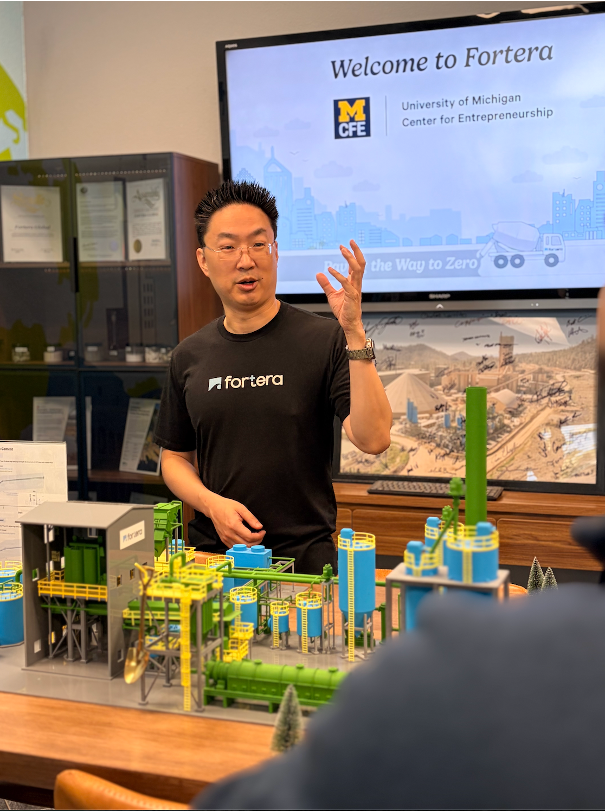
We were given a tour of their “playground,” a sophisticated mix of high-tech labs and a miniature model of their production plant. The science came to life as we walked through the ReACt platform, which is now a commercial reality. Fortera recently celebrated the opening of its first industrial-scale plant in Redding, California, marking a massive leap toward decarbonizing the global construction industry. To date, the company has raised over $140 million from top-tier investors like Temasek and Khosla Ventures to scale this mission.
A technical differentiator, however, only gets you halfway. According to Ryan, what separates a good entrepreneur from a great one is conviction.
“The only thing that truly defines success is perseverance,” Ryan noted. “You either decide to keep moving forward or walk away when things get really tough. Conviction is key.”
2. Building the right team and establishing a clear company culture is the “secret sauce” of a successful startup
There are no better people to speak to team spirit than Inventure. This premier medical innovation incubator has raised significant capital to launch high-impact companies, including Endovascular Engineering (E2) and Ladera Medical.
Our visit coincided with the tail end of a Cinco de Mayo celebration–just one of many activities used to strengthen community within the incubator. “New companies need to build teams with the right experience at the right time,” noted Keri Ng, COO of Inventure Group. During a tour of their “campus”–a sprawling complex in Menlo Park–she emphasized that “culture is really important when you start a company.” This isn’t just corporate-speak; the campus backs it up with a back lot featuring basketball and tennis courts, and they even got ahead of the trend with a dedicated pickleball court.
What truly defines Inventure, however, is its culture of resource sharing. Beyond mentorship, they provide the heavy-duty infrastructure required to navigate the grueling medical device gauntlet. Their 20,000-square-foot facility includes in-house cleanrooms, dual machine shops, 3D printing, and specialized labs for prototyping everything from optics to complex catheters. This allows entrepreneurs to move from a napkin sketch to a simulated-use model without leaving the campus.
One standout company within Inventure is E2, which is about to go to market with its specialized clot-catching catheter designed to safely clear major blockages. Its roots trace back to the University of Michigan, where it was launched as a spinoff through a collaboration between the Michigan Biodmedical Venture Fund and the Inventure group.
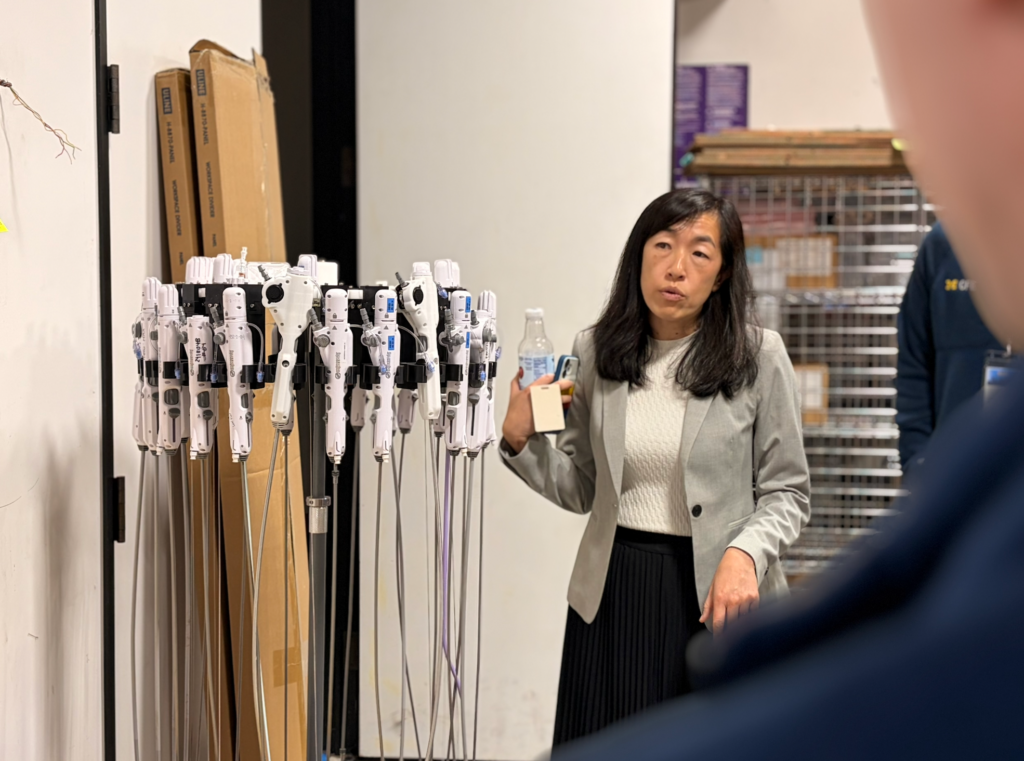
E2’s journey is a masterclass in the creative pivot. While the foundation technology was born in the high-stakes world of neurosurgery, the team realized their dual-action clot-removal system could address an even larger unmet need in the venous system. They capitalized on their focus on Venous Thromboembolism (VTE), a condition where a blood clot forms in the deep veins (usually the legs) and can travel to the lungs, causing a sudden, life-threatening blockage.
Moving its focus from the delicate arteries of the brain to the larger venous system–accessed via the femur–allows the technology to tackle massive lung clots with a “blood return” system that significantly reduces procedural complaints. This evolution culminated in a massive $80 Million Series C round in April 2026 to advance their Hēlo™ PE Thrombectomy System.
This strategic shift fascinated Mousa Alhazmi (PJTL HealthTech), a physician assistant and health informatics graduate student: “They pivoted from the brain to the femur to access the lungs, choosing a path with fewer complications for the patient. My takeaway is that to find the most effective solution, you must be willing to pivot away from your original target if the data and the experts show you a better way to help people.”
By combining Michigan’s academic rigor with Inventure’s “fail-fast, build-fast” infrastructure, E2 transformed from a specialized neuro-concept into a powerhouse of vascular innovation.
3. Failure is not a consequence; it’s an opportunity to grow
For Day 2, our feet led us to the expansive warehouse of Mytra, a robotics and automation company redefining one of the most fundamental industrial tasks: the movement and storage of material. Using a flexible, software-defined approach, Mytra’s system deploys autonomous bots to move payloads of up to 3,000 lbs in any direction, using pallets that feature what they call “a screw with wheels.”
Despite raising an enviable $200M+ in venture capital since its founding in 2022, the folks at Mytra displayed a refreshing lack of ego, leaning openly into the necessity of failure. To prove it, they showcased three distinct generations of their hardware, laid out like an evolutionary timeline of lessons learned.
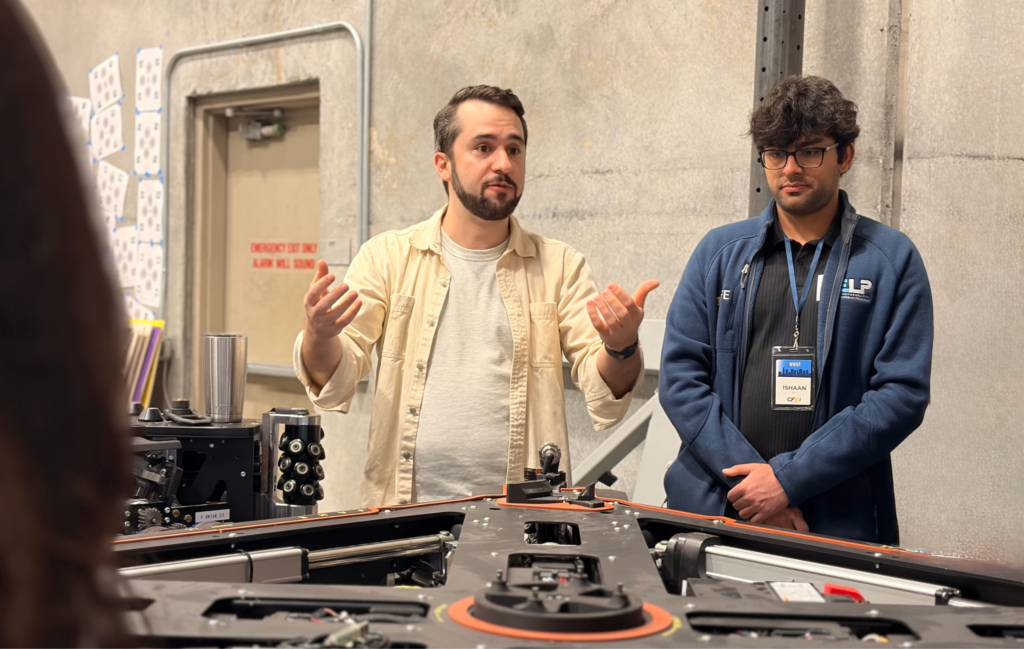
“For every iteration, you learn something about the architecture,” explained John Paton, Lead of Commercial Intelligence and Technical Sales. As he walked us through the older versions of the bots, he pointed out specific growing pains–from structural weight distribution issues to sensor calibration errors–before introducing us to the latest generation of bots currently undergoing rigorous stress tests. John noted that while these “failed” prototypes came with high financial costs, they were essential to the engineering process: “You have to spend money to understand the problem even more.”
Tony Valencia (PJTL Air and Space Track), an aspiring electrical engineer, was enamored by Mytra’s candor about forcing failure during the pilot stages. “I really appreciated that Mytra was willing to exhaust resources to watch their product fail in-house,” Tony reflected. “It made me realize that while there’s an upfront cost to testing and breaking things now, there’s no higher cost than deploying a failing product to a client later on.”
4. people will sway you away from doing meaningful things: Resist
Entrepreneurship seeks to provide real solutions to real problems, and for Eat Just Co-Founder and CEO and Michigan alumnus Josh Tetrick, one of those real problems is the unsustainable mass production of food, particularly eggs, one of the most consumed animal products globally.
The scale of this problem is staggering: feeding the world’s chickens requires a landmass the size of Texas and California combined–roughly 113 million hectares. Even more alarming is the thirst of these crops; every year, they consume enough water to drain Lake Erie dry.
For Josh, replacing the traditional egg will not only help make these food systems more sustainable but also reduce animal suffering. “Do the thing that needs to be solved,” Josh said, “Animal harm, excessive carbon footprints, homelessness. These are not made up, but are real and legitimate.”
These meaningful ventures, however, do not come without resistance from your friends, family, peers, and even the world at large, Josh says, which is why aspiring founders need to persist and “put energy and powers on that meaningful thing, back to where your heart belongs.”
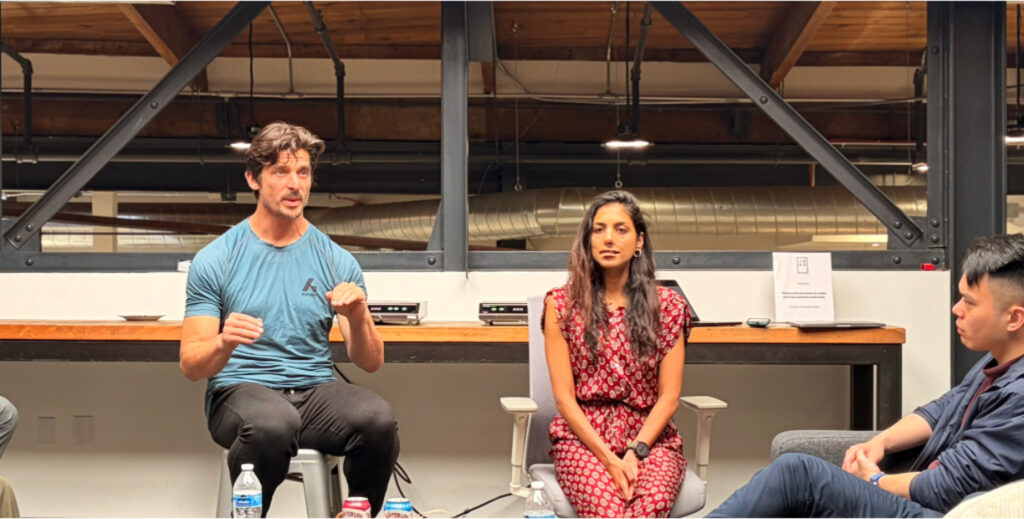
One such act of persistence was displayed by rising senior Lucas Hong (PJTL Electrification), who had a rare chance to pitch a meaningful idea directly to Josh. As part of the company visit’s “innovation challenge,” one prompt asked students to develop a go-to-market plan to convert ardent non-vegans into product adopters. Lucas and his team targeted bodybuilders and athletes, segments acutely conscious of macronutrients, proposing a benchmark study or clinical trial to prove and publicize that Eat Just’s plant-based products are a viable substitute.
“At first it was very intimidating, just because of the level of prestige, I’m just a student, and he’s founding this company,” Lucas said when asked how he felt about pitching directly to the founder. “But over time it just started to feel more and more natural, like there was no gap; like I was simply talking to him about something that he really cares about.”
5. Being different is your superpower: there is space for women in tech innovation
Undoubtedly, the start-up space remains a male-dominated industry, and the numbers bear this out: only about 2% of total venture capital funding in 2024 went to all-female founding teams, even though data suggests that women-led startups generate 78 cents of revenue for every dollar raised, compared to just 31 cents for male-led start-ups.
This stark reality was not lost on our own cohort, which included only about one-third female participants. Additionally, only 1 out of the 6 companies we visited had a female founder: Lume Health, co-founded by Michigan alumna and ELP 2017 Cohort member Vicki Powell, alongside medical doctor Jonathan Moustakis.
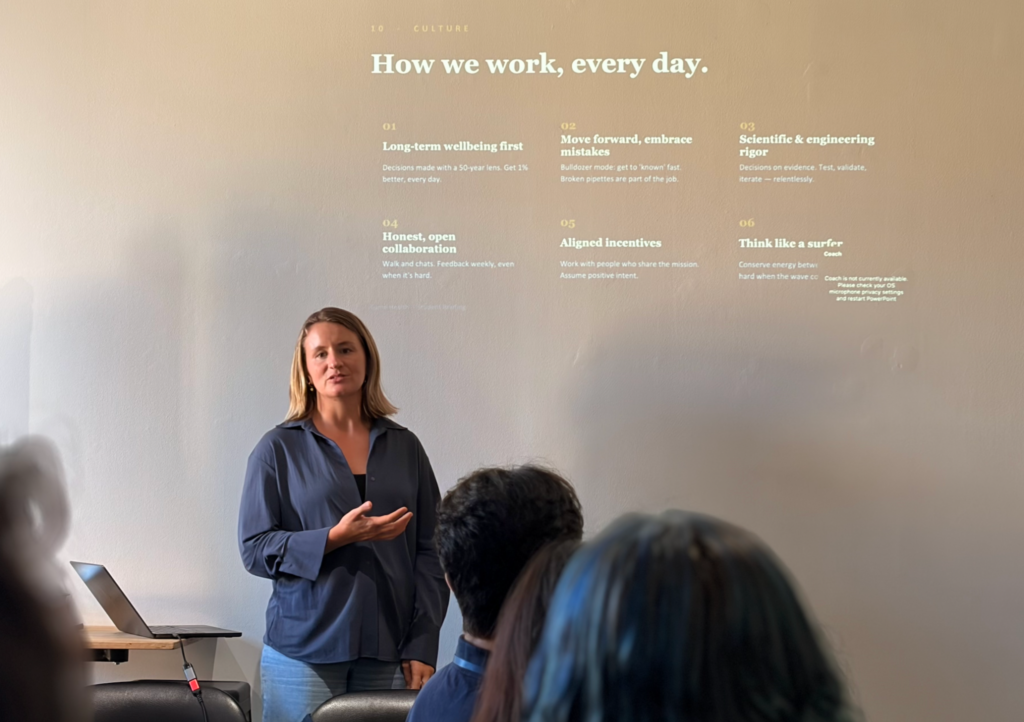
Lume Health aims to be a game-changer in wearables, becoming the first needle-free monitor to measure hormones continuously. Their differentiator? Most wearable monitoring technology today measures proxy metrics like heart rate variability, skin temperature, and step counts. Lume aims to measure markers at the molecular level (e.g., cortisol, estrogen, and more) via sweat.
“I’ve existed in a lot of male-dominated spaces in my life, being an engineer,” Vicki admits, “But being different is a superpower. I can bring a perspective that no one else in the room here can, and that’s actually an advantage; not something to be fearful of, but something to be proud of.”
Rising robotics senior Leyna Nguyen (PJTL MCity), who was on the winning team of Lume Health’s innovation challenge of producing a 15-second vertical video marketing Lume’s flagship product, echoes this sentiment and was inspired to see a woman leading a predominantly male team. She hopes to become the next woman in that space.

“Representation is important because in this day and age, unfortunately, engineering is contributing to more widening divides than solving for them,” Leyna posits. “I know that I have value in this market as someone who is part of an underrepresented population. It makes my insights more valuable.”
This trek also gave economics senior Jessica Bae (ELP) motivation to push even harder, especially after hearing from the Lume founder herself. “Seeing how successful she was has really inspired me to keep chasing after what I want and also speaking in rooms even when it may be uncomfortable,” Jessica says.
There is an uphill climb ahead for women in tech, but the trail is being blazed by those who refuse to be silenced by the statistics. While the current VC landscape remains lopsided, a shift is underway as more women-led companies move toward becoming household names – from Whitney Wolfe Herd, who took Bumble public as the youngest female founder to do so, to Melanie Perkins of Canva and Julia Hartz of Eventbrite. They are living proof that when women lead, they dominate.
As Leyna, Jessica, and the rest of the WUST Trek cohort witnessed through Vicki Powell’s journey with Lume, the space for women in innovation isn’t simply given on a silver platter; it’s being built.
“There’s a huge opportunity for women entrepreneurs to really bring truly differentiated products to market and build really differentiated companies and cultures. I think people may be a bit sick of the same old things,” Vicki concludes.
6. What do investors look for? The F.I.T. Framework
What’s a more fitting way to end the San Francisco trek than in conversation with a multi-hyphenated investor, Michigan alumnus, and CFE adviser himself: Jeff Schox. He has funded over 250 early-stage startups, crafted over 500 patent applications through a patent firm he founded, and taught patent law and innovation strategy to over 700 students at Stanford, with more than 20 years of in-depth industry experience.
Those years led him to craft a deceptively simple winning formula for getting investors interested, one that had most of the CFE trekkers reaching for their notes: the F.I.T. Framework, which stands for Founder-Insight-Timing.
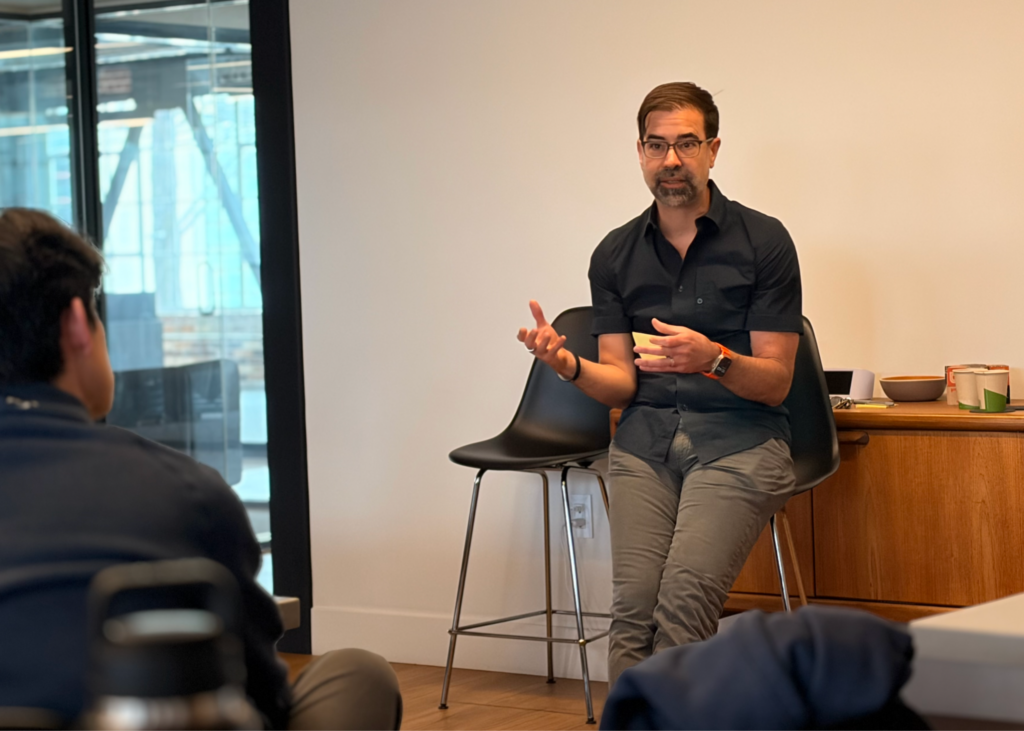
“I want to know the story of the founder, their background, which led to the insight that is counterintuitive, contrarian even, and really makes you think; something that has not been done before,” Jeff said. “The only way I get to believe is to hear how the founder arrived at that insight.”
Timing, he added, is also a crucial element that forward-looking investors watch for: Why now? Why is this the right time to do this? What are the trends that show that this is important now? Is this a good time for this idea?
These questions challenged computer science and engineering graduate student Adam Kuca (ELP) from the Czech Republic, who is developing his own software infrastructure for small and medium-sized enterprises in the European Union.
“I feel like timing is rarely considered in start-up work, especially the 3-to-5 year horizon. Many founders don’t think enough about the future and don’t build for it. It is often just considered luck. I am trying to think about the timing more myself now after the talk,” he commented, after an endearing and quite candid sit-down with Jeff, who also covered topics on patent law and personal leadership.
To compress into a few paragraphs the wealth of wisdom in that two-and-a-half-day San Francisco trek is an impossible task, one that needs to be lived to be fully absorbed That’s why Lucas hopes other aspiring entrepreneurs at Michigan make it their mission to join a future trek: “Attending one of these treks will not only motivate you, but it will also get rid of that fear factor that stops a lot of people from pursuing entrepreneurship in the first place.”
As for me, I come back to Ann Arbor with a renewed spirit and an even stronger drive to scale. What struck me most during the trek was not the glamour of venture capital or million-dollar valuations, but the uncertainty behind it all. Nearly every founder we met spoke openly about failure, doubt, pivots, and the constant possibility that things could collapse.
And yet they kept building anyway.
This may be the real lesson San Francisco offered us. Not that innovation belongs exclusively to genius founders or elite tech ecosystems, but that meaningful work often begins with the willingness to persist long before success is guaranteed.
Having founded an environmental journalism nonprofit back in the Philippines myself, that lesson felt especially personal. Building anything mission-driven, whether a startup, a newsroom, or a social enterprise, often means continuing forward even when certainty, funding, and outcomes remain unclear.
For those of us returning to classrooms, labs, nonprofits, and startups of our own, that may be the hardest challenge, and the most important one.
Author’s Note: Some quotes were edited to improve clarity and ensure brevity.