

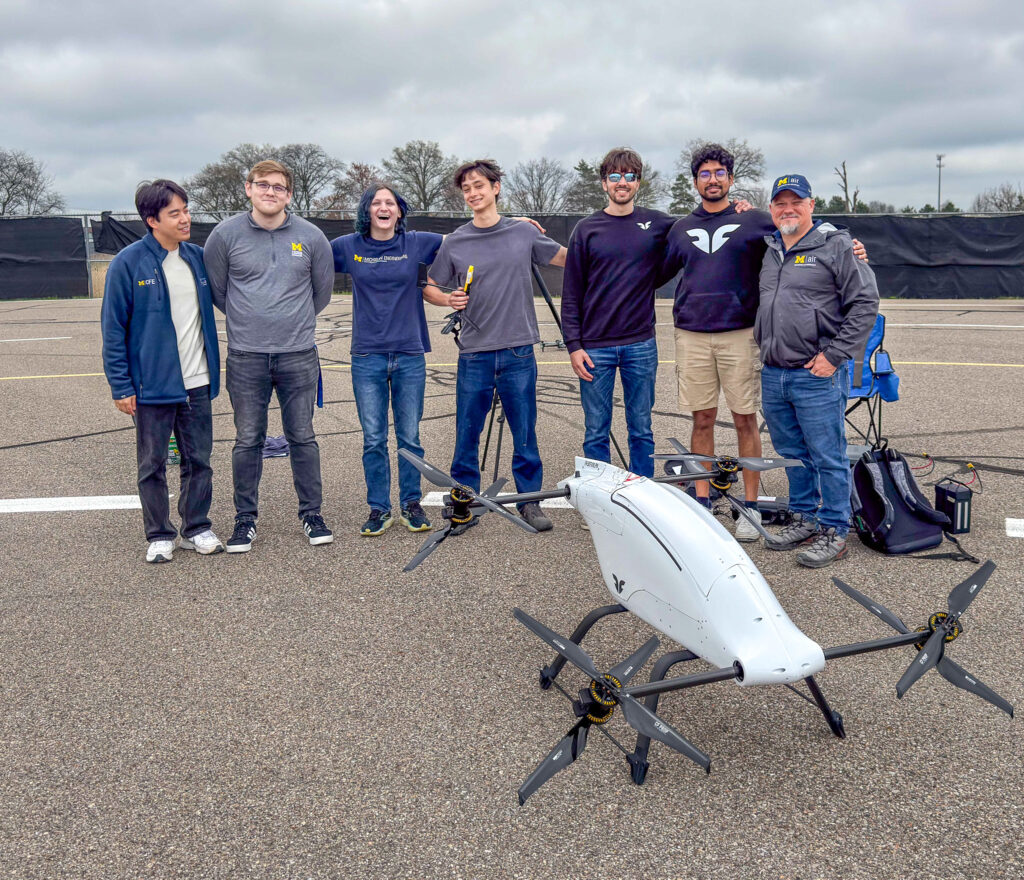
ANN ARBOR, Mich. — The Center for Entrepreneurship (CFE) at the University of Michigan launches the 2027 cohort for its Perot Jain TechLab Air & Space program. Emerging from a summer recruitment drive that attracted over 40 applications from aerospace and spacetech companies worldwide, six startups were selected to partner with U-M student teams.
PJTL Air & Space connects students with innovators in advanced aviation, uncrewed aerial systems, and space technology. Over a two-semester commitment, four-person student teams studying Aerospace Engineering, Computer Science, Robotics, Physics, or any other relevant academic pathway tackle exploratory technical projects defined by startup founders. Startups receive dedicated R&D execution, access to U-M research infrastructure, including the new M-air testing and development facility, the Great Lakes HPC cluster, and direct recruitment pipelines at no financial cost, while retaining full ownership of all intellectual property.

SkyGig (Bay Area, CA) — Founded by U-M researchers, SkyGig develops power-optimized wireless transceiver architectures for 5G-Advanced, 6G, and satcom networks. Students will build a reconfigurable testbed for ground-to-drone 6G communications and execute Software-Defined Radio (SDR) field measurements at the Mcity proving grounds.

blueflite (Brighton, MI) — blueflite manufactures tilt-rotor VTOL cargo drones (Cobalt) with climate-controlled cargo bays for time-critical medical delivery. Over two semesters, students will research, design, prototype, and bench-test a compact, lightweight winch delivery mechanism with automated 10 lb payload release and fault recovery.

Firefly Aerospace (Cedar Park, TX) — Firefly Aerospace operates launch vehicles (Alpha), lunar landers (Blue Ghost), and orbital transfer vehicles (Elytra). Students will advance the “Eclipse Catch” legless ground-recovery system for reusable launch vehicles by refining GNC vision-targeting algorithms and conducting flight tests with scaled hardware.

Aurelia Institute (Cambridge, MA) — spun out of the MIT Media Lab — develops next-generation space habitats. Students will redesign a mechatronic tile-based deployable system, TESSERAE Transform, for applications on the lunar surface, engineering solutions for regolith dust, thermal extremes, and partial gravity.
Skydweller (Oklahoma City, OK) — Skydweller develops uncrewed solar-electric aircraft with a 236-foot wingspan designed for perpetual flight missions. Student teams will prototype an AI supervisory mission planning system integrating dynamic weather, solar radiation, and battery storage models to optimize autonomous long-endurance flight paths.
Orbital Arc (Houston, TX) — Orbital Arc develops Gas-Phase Field Effect Electric Propulsion (Gas FEEP) using solid naphthalene fuel for deep-space transport. Students will assemble specialized diagnostic equipment and execute TRL 6 flight qualification test procedures—measuring thrust, plume divergence, and beam stability—at U-M’s Plasmadynamics & Electric Propulsion Laboratory (PEPL).